 Play it on the globe →
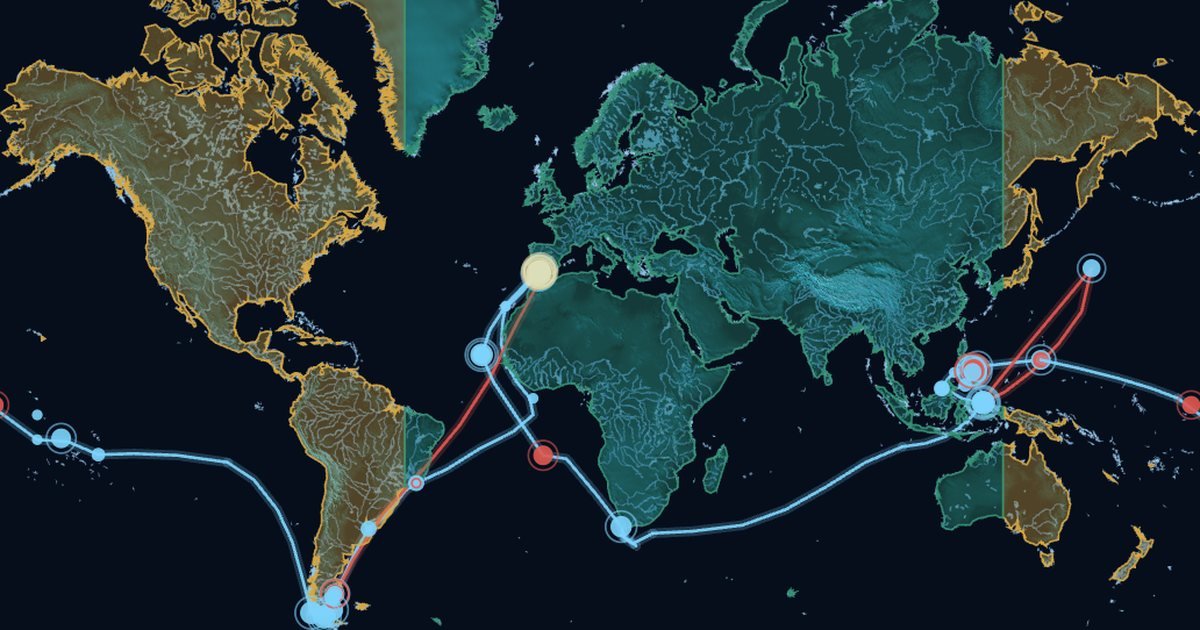
The voyage that closed the world. Five ships and 270 men leave Seville in August 1519; one ship and eighteen men come back three years later, and Magellan is not among them. The two halves of the map are the Treaty of Tordesillas, which had divided the globe along a meridian in 1494 without settling where that line fell on the far side — the question the Moluccas made worth answering. Dates from Wikipedia and from Pigafetta, who was aboard; open-sea tracks are plausible routes, not logged positions.
How this is made →59events
28routes
1 August 1519 – 31 October 1522span
Explorationcategory
The voyageDeaths and disasters
What is on the map
- 51 The voyage
- 8 Deaths
Chronology
- Seville: five ships and about 270 men drop down the Guadalquivirdeparture▸
- Sanlúcar de Barrameda: the fleet stands out to seadeparture▸
- Tenerife: taking on water, and a warning that Cartagena means to mutinyport▸
- Magellan sails south along Africa instead of west, and his captains objectsail▸
- Weeks of squalls on the equator; St Elmo’s fire on the mastheadssail▸
- Rio de Janeiro: thirteen days of plenty, in a bay that is Portuguese by treatyport▸
- Salomón strangled for sodomy after a trial on the Trinidaddeath▸
- South again, hugging a coast no chart shows correctlysail▸
- Río de la Plata: three weeks probing what turns out to be a river, not a straitlandfall▸
- Southward into cold no European had sailedsail▸
- Port St Julian: five months of winter at 49° south, on half rationsport▸
- Easter night: three captains seize three ships. Quesada stabs the master of the San Antoniomutiny▸
- Espinosa is rowed to the Victoria with a hidden knife and kills Mendozamutiny▸
- Quesada beheaded and quartered; the bodies left on gibbets all winterdeath▸
- The Santiago is sent ahead and finds the Santa Cruz riversail▸
- The Santiago is driven ashore and broken up. Every man survives; four ships remainwreck▸
- The first meeting with the Tehuelche, whom Magellan calls Patagonesencounter▸
- Cartagena and the priest Reina are marooned with two swords and some biscuit. They are never seen againmutiny▸
- St Julian abandoned: four ships, about 230 mensail▸
- South from Santa Cruz, with orders to search to 75° if need besail▸
- Cape Virgenes: a bay opens west, and the water stays salt all the way inlandfall▸
- The Strait of All Saints: 570 kilometres of channel, cliffs and blind armsstrait▸
- The San Antonio turns back in the night with most of the stores, and sails homedesertion▸
- Three ships come out into an ocean so calm Magellan names it Pacificstrait▸
- A small island with no water — they call it San Pablo and cannot landlandfall▸
- Biscuit turned to powder and worms, water yellow, rats sold for half a ducathardship▸
- The equator again, still no land, ninety days without fresh foodsail▸
- A second barren island, named the Sharkslandfall▸
- Nineteen men are dead of scurvy; thirty more cannot standdeath▸
- Guam, after ninety-eight days at sea. The Chamorro take a skiff and are called thieves for itlandfall▸
- A landing party burns forty houses and kills seven Chamorro over the stolen boatmassacre▸
- Samar sighted: the Philippines, though nobody yet knows what they arelandfall▸
- Homonhon: fresh water and coconuts, and the sick begin to recoverport▸
- Off Limasawa, Enrique of Malacca is understood by the men in the canoe. The world has been closedencounter▸
- Easter mass on Limasawa, and a cross set on the highest hillritual▸
- Cebu: Rajah Humabon takes the fleet in, and blood is drawn for a pactport▸
- Humabon, his queen and some 2,200 people are baptised in a weekritual▸
- Mactan: Magellan wades ashore with sixty men against fifteen hundred, and is killed in the shallowsbattle▸
- Cebu: twenty-seven officers are killed at a farewell banquet, Barbosa and Serrano among themmassacre▸
- Too few men for three ships: the Concepción is stripped and burnt off Boholwreck▸
- The deserting San Antonio reaches Seville first, and its officers testify against a dead manarrival▸
- Palawan, which they call the land of promise, for the riceport▸
- Brunei: elephants, a city on stilts, and 62 pieces of brass artillery counted in the palaceencounter▸
- The fleet, now frankly pirates, takes a junk bound for China and holds its captainpiracy▸
- Carvalho is deposed. Espinosa takes the Trinidad, Elcano the Victoriamutiny▸
- Tidore, in the Moluccas: the reason for everything, reached at last with 115 menlandfall▸
- Al-Mansur sells cloves for cloth and knives. The holds are filled with 26 tonstrade▸
- The Trinidad, loaded, is found leaking badly and cannot sailwreck▸
- The Victoria leaves alone with 47 men, west, into a sea Portugal patrolsdeparture▸
- The Trinidad tries the other way — east, back across the Pacific to Panamadeparture▸
- The Cape of Good Hope, on the fifth attempt, with the yards under watersail▸
- The Trinidad reaches 42° north, finds only storms, and turns backsail▸
- Rice and water. Twenty men die between the Cape and Cape Verdedeath▸
- Cape Verde: they beg provisions from the Portuguese, pretending to come from Americaport▸
- Ashore it is Thursday; aboard, kept scrupulously, it is Wednesday. Sailing west has cost them a daydiscovery▸
- Thirteen men are seized when the cloves give them away. The Victoria runs with eighteencapture▸
- Sanlúcar: one ship, eighteen men, three years short of a month. The cargo pays for the whole expeditionarrival▸
- Seville: they walk barefoot in shirts to Santa María de la Victoria, carrying candlesarrival▸
- The Trinidad, back at the Moluccas, is taken by the Portuguese. Four of her men see Spain again, in 1526capture▸
Routes and campaigns
- Down the Guadalquivir
- Sanlúcar to the Canaries
- South along Africa, against his captains’ advice
- The doldrums, and then the south-east trades
- Down the Brazilian coast
- Into Patagonia, feeling for a strait
- The Santiago scouts ahead
- St Julian abandoned
- South to Cape Virgenes
- Through the strait
- The San Antonio deserts and runs for Spain
- North-west into the Pacific
- Across an empty ocean
- North-west again, crossing the line
- The Ladrones
- Into the Philippines
- Limasawa, and then Cebu
- Adrift among the islands, burning a ship
- Palawan to Brunei
- South-east at last, to the Moluccas
- The Victoria alone, west through the Indies
- Across the Indian Ocean, out of sight of every port
- Nine weeks beaten back from the Cape
- The Trinidad tries the Pacific eastward, and is beaten back
- Round the Cape at last, with the yards under water
- North up the Atlantic on rice and rainwater
- The last leg, running from the Portuguese
- Up the Guadalquivir to Seville
Background reading: the parent article.
Other stories
Out of AfricaHow one species took the whole planet, 300,000 BC – AD 1300The Discovery of the Pacific IslandsFinding a third of the planet without instruments, 3000 BC - AD 1500RomeA thousand years of one border, 509 BC – AD 565The Unification of ChinaFrom the partition of Jin to the founding of Han, 403–202 BCThe Gallic WarsCaesar's conquest of Gaul, 58–50 BCGenghis KhanFrom a boy on the Onon to the Caspian, c. 1162–1227Marco Polo's TravelsVenice to Xanadu and back, 1271–1295The Hundred Years' WarFrom the seizure of Aquitaine to the fall of Bordeaux, 1337–1453The Black DeathSix years, and a third of Europe, 1346–1353The Unification of JapanFrom the Ōnin War to the fall of Osaka, 1467–1615The Discovery of AmericaFifty-three years, from a beach in the Bahamas to the silver of Potosí, 1492–1545Volcanic EruptionsEvery significant eruption on record since 1500How America Filled UpEvery American city of 60,000 people, in the year it beganNapoleonFrom Ajaccio to Saint Helena, 1769–1821The American RevolutionFrom Lexington to the last ship out of New York, 1775–1783The American Civil WarOne country, torn in two and taken back battle by battle, 1860–1865Women's SuffrageA map filling in, one country at a time, 1893-2012The First World WarSarajevo to Versailles, five years to the dayThe Second World WarFrom the Marco Polo Bridge to Tokyo Bay, 1937–1945DecolonisationHow a third of the world stopped belonging to somebody else, 1945–1990Nuclear detonationsEvery recorded nuclear test, 1945–1998